
OUR SERVICES
Basement Waterproofing Services in Lima, OH
Four ways to keep water out of a Lima basement, plus honest pricing on all of them. Which one you need depends on what your foundation is made of and where the water is coming from — and those answers are not interchangeable. A hollow block wall full of water is a different job from a perched water table pushing up through the slab. Start with the service that matches your symptom, or call (419) 731-9193 and we will tell you which one applies.
Interior Drainage & Sump Pumps
Drain tile installed below floor level in washed gravel, routed to a sealed sump basin with a bolted lid and a grommeted discharge. This is the correct answer for water arriving from underneath — a perched water table pushing up through the slab or in at the wall-floor joint. It is also the most oversold service in this trade, and done as a shortcut it is a plastic channel glued to the floor that will not manage Lima's clay.
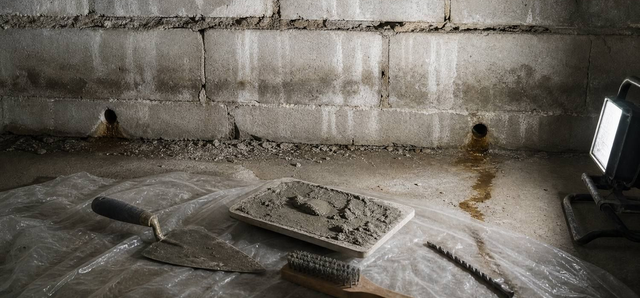
Block Wall & Foundation Repair
Most Lima basements built during the war and postwar expansion sit on hollow concrete block. The mortar joints deteriorate and the cores fill with water, which means the wall is holding water inside it — drill a weep hole at the base course and it pours out. We repoint the failed joints, drain the cores, and fix what is putting water against the wall. Crack injection is the wrong tool here.
Exterior Waterproofing & French Drains
Excavation down to the footing, membrane applied to the wall, perforated pipe bedded in washed gravel, and backfill that drains instead of holding water. It is the most expensive option and the most permanent, and in Allen County clay it is sometimes the only thing that actually works. We will tell you plainly when it is not necessary.
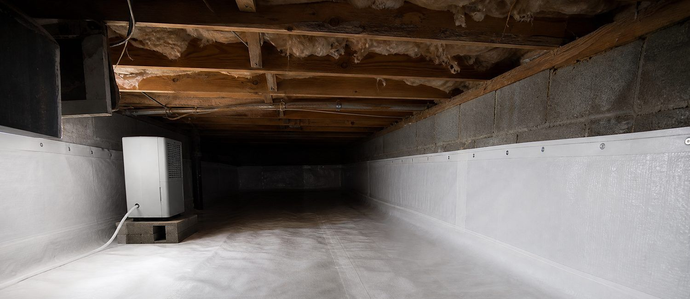
Crawl Space Encapsulation
Heavy reinforced liner across the floor and up the walls, mechanically fastened at a termination strip with every seam sealed, plus a dehumidifier sized to the space. A crawl space with exposed dirt is feeding humidity into the whole house through the floor. A sheet of plastic laid loose on the ground is not encapsulation.
Basement Waterproofing Cost
Real price ranges for every service on this site, published openly with the reasoning behind each number. Nobody else in this market puts figures on a page, which is exactly why we do. You should be able to work out roughly what your job costs before you talk to anyone.
SIGNS TO WATCH FOR
When you need basement waterproofing in Lima
The obvious sign is standing water, but most Lima basements warn you long before that. White chalky efflorescence blooming on block walls means water is moving through the masonry and leaving minerals behind. A damp tide line across the lower courses that darkens after rain and dries between storms means the wall is wicking. Stair-step cracking that follows the mortar joints across several courses is the signature failure of a block wall under lateral pressure. Rust stains trailing from a weep hole or a crack mean water has been sitting inside the wall long enough to corrode something. A musty smell that gets worse in humid weather usually means an unsealed crawl space, not the basement itself. And a sump pump that runs continuously in April is telling you the water table is above your floor, not that the pump is faulty.
Get Your Free Quote
No obligation. No pressure. We reply within one business day.
ROOT CAUSES
Why basements take water in Lima and Allen County
Three conditions overlap here, and each one alone would be enough to cause trouble. Lima sits in what was the Great Black Swamp, a glacial wetland that covered northwest Ohio until it was artificially drained in the nineteenth century for farming and settlement — the city is named after Lima, Peru, because Peru supplied the quinine this malarial region needed. That drainage is engineered, not natural, and the water still wants to be where it was. Underneath is clay loam over glacial till, and the Allen County soil survey documents the seasonal high water table within roughly six and a half feet of the surface, shallower than most basement floors. Clay does not let water pass, so it perches on top and spreads sideways looking for the lowest opening. Then there is the Ottawa River, which locals call Hawg Creek, running through the middle of the city with five lowhead dams built between 1931 and 1956 sitting inside the city limits. Those impoundments hold water levels artificially high year-round, which is why one house floods every spring while a neighbor three streets away on higher ground stays dry through the same storm.
BUDGETING
What affects the cost of waterproofing a Lima basement
Linear footage is the biggest single factor — interior drainage is priced by the foot of wall treated, so a single wall costs a fraction of a full perimeter. After that it is access. A walkout basement with a clear exterior grade is straightforward; a foundation with a deck, a patio, mature landscaping or a driveway over the excavation line adds real cost, and sometimes rules exterior work out entirely. Foundation type matters more in Lima than in most markets, because a hollow block wall needs its cores drained and its joints repointed, which is work a poured concrete wall does not require. Depth drives exterior pricing directly, since the trench has to reach the footing and the spoil has to go somewhere. Then there are the fixed items: the permit from Allen County Public Health, the pump and the battery backup, and the discharge routing, which has to go to daylight or storm drainage rather than the sanitary sewer. We publish real ranges for all of it rather than making you call to find out.
DECISION GUIDE
Interior or exterior — how to decide
The honest rule is that interior drainage manages water and exterior waterproofing prevents it, and which one you need depends on where the water comes from rather than on which is better. If water is arriving from underneath — up through the slab, in at the wall-floor joint, worse in spring than during any single storm — that is a water table problem and interior drainage is the right answer regardless of what an exterior sales pitch says. If water is running down the inside face of the wall during heavy rain, arriving through the block cores or a crack above floor level, that is surface water and the fix is outside: grading, downspouts, and if those are already right, excavation and membrane. Where it gets genuinely difficult is a hollow block wall in Lima clay taking water from both directions, which is common in the postwar stock. Sometimes that needs both, and any contractor who tells you otherwise without opening the wall is guessing.
WHY US
Why choose our team for your basement
Most of the large waterproofing companies quoting jobs in Lima are dispatching from Toledo, Dayton, Fort Wayne or Columbus, all of them more than an hour out. They arrive with a system to sell rather than a wall to diagnose, and in a market where the housing stock is mostly hollow block sitting in drained swamp, that difference shows up in the price and in whether the fix holds.
- Local crews based in Allen County, not dispatched from another metro
- Registered with the City of Lima and registered and bonded with Allen County Public Health for plumbing work
- Written fixed-price quotes from an on-site diagnosis, never a phone estimate
- Repairs matched to hollow block construction, which is most of Lima's basements
GOOD TO KNOW
Frequently Asked Questions
Which service do I actually need?
Start with where the water appears. Coming up through the floor or in at the joint where the wall meets the floor points to interior drainage. Running down the face of the wall during heavy rain points to exterior work or, more often, to grading and downspouts. Dampness and musty smell with no visible water usually means the crawl space. A block wall with efflorescence and stair-step cracking needs the cores drained and the joints repointed whatever else you do. If two of those describe your basement, you may need two things — which is why the inspection is free.
Is interior drainage a real fix or just managing the problem?
It is managing the problem, and in Lima that is often the correct engineering choice rather than a compromise. You cannot lower the regional water table. What you can do is give the water a path to a sump and out, so it never builds pressure against the slab or the wall. The distinction that matters is not interior versus exterior — it is whether the drain tile is actually installed below floor level in washed gravel, or whether someone glued a channel to the top of your slab and called it a system.
Why can't you just quote over the phone?
Because the same symptom has several causes here and they differ by thousands of dollars. Water along one wall could be a perched water table, a block wall full of water in the cores, or a downspout discharging two feet from the foundation. The first is a drainage system, the second is masonry work, the third costs almost nothing. Quoting that blind means either overcharging you or discovering mid-job that the price was wrong.
Do you handle the permits?
Yes, and it is worth knowing why that matters here. Plumbing permits for sump work come from Allen County Public Health rather than the city building department, and they must be pulled before work begins by a contractor registered and bonded with the department. A homeowner can pull their own, but only if they live at the residence and sign a notarized affidavit stating so. Building permits inside the city limits are a separate office with its own registration requirements. We deal with all of it.
How long does the work take?
Interior drainage on one or two walls is usually one to two days. A full perimeter runs two to three. Block wall repointing with core drainage depends on how much wall is affected — typically one to three days. Crawl space encapsulation is one to two days for most Lima crawl spaces. Exterior excavation is the long one at three to five days, and it is weather-dependent, because an open trench in Allen County clay and a heavy rain do not mix.
Not sure which one you need?
That is the normal starting point. A free on-site inspection tells you which service applies, what is causing the water, and what it costs — in writing, with no obligation.