
BASEMENT WATERPROOFING · LIMA, OH
Block Wall & Foundation Repair in Lima, OH
Most Lima basements built during the war and postwar expansion sit on hollow concrete block, and block does not fail the way poured concrete fails. The mortar joints deteriorate, water gets into the wall, and the hollow cores fill up — drill a weep hole at the base course of a wet block wall and water pours out of it. That is a wall holding water inside itself, and crack injection cannot fix it because there is nothing solid to inject and the water is in the core rather than in a crack. We repoint the failed joints, drain the cores, and correct what is putting water against the wall. Call (419) 731-9193 for a free on-site inspection.
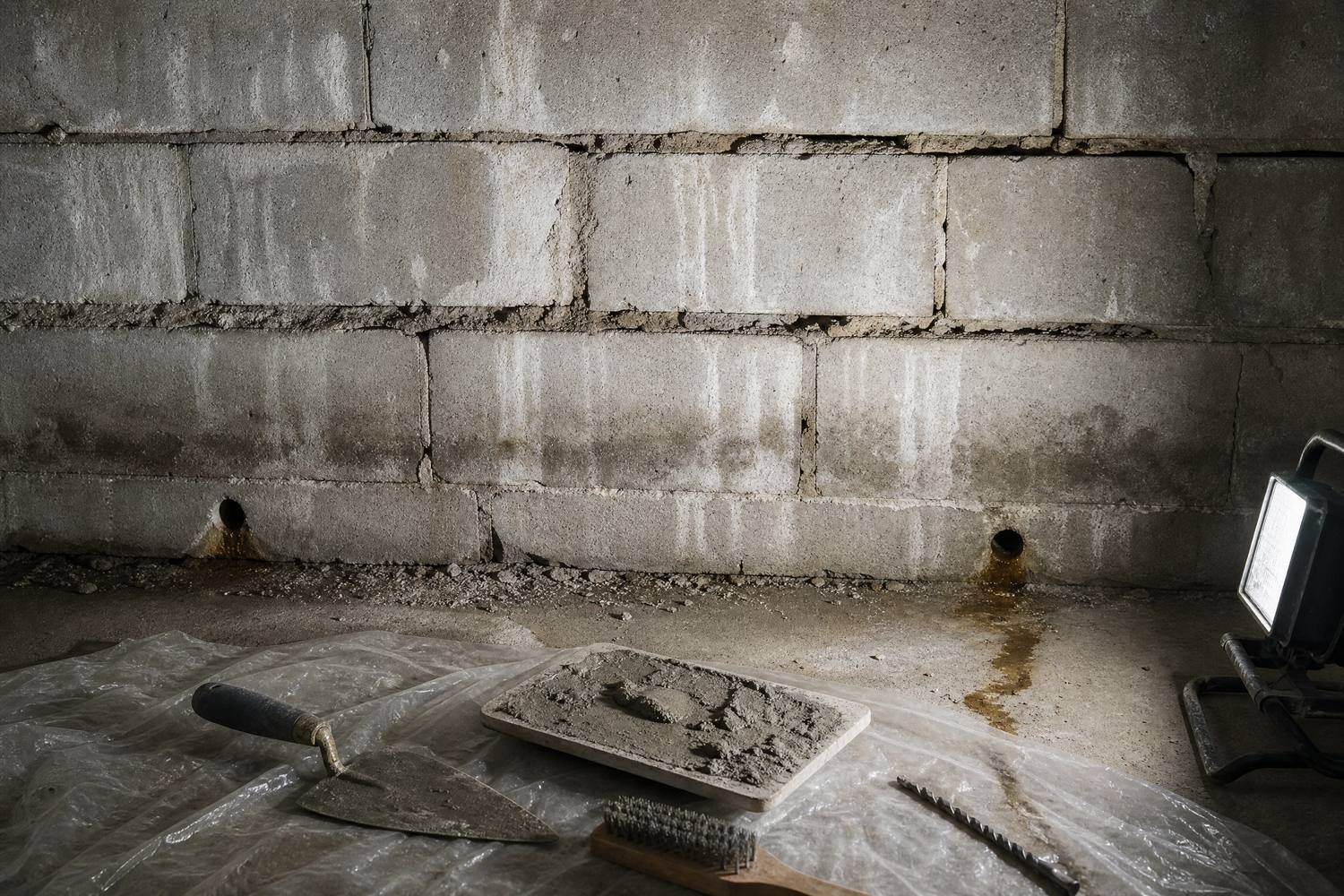
What block wall repair involves
We start by finding out how much water is actually inside the wall, which means drilling test weeps into the base course and watching what comes out. On a saturated block wall that is a genuine flow, not a trickle. Those weep holes then stay as permanent drainage, routed into a drain tile system at the footing so the cores empty instead of standing full. Next we cut out the failed mortar joints back to sound material and repoint them with a mortar matched to the block — struck and tooled so the joint sheds water rather than holding it. Where individual blocks have spalled or cracked through, we cut them out and replace them.
The part most quotes skip is the outside. A block wall that keeps filling with water is being fed by something, and nine times out of ten it is grading that slopes toward the house, a downspout discharging within a couple of feet of the foundation, or a window well with no drainage. Repointing a wall and leaving that in place means the joints fail again. Where the wall is bowing rather than just leaking — a stair-step crack that has opened and moved, or a visible inward deflection — that is a structural question rather than a water one, and we will tell you plainly if it needs carbon fiber straps or steel bracing rather than masonry work.
When you need block wall repair: signs and situations
These are the symptoms specific to hollow block construction, which is what most Lima basements are built from.
- Stair-step cracking that follows the mortar joints diagonally across several courses
- White chalky efflorescence blooming on the block face, heaviest on the lower courses
- Mortar you can rake out with a screwdriver, or joints that have receded behind the block face
- Water appearing partway up the wall rather than at the floor, meaning it is coming through the cores
- A damp band across the wall that darkens after rain and dries between storms
- Rust staining trailing down from a joint or crack, meaning water has been standing in the wall
Get Your Free Quote
Why block walls fail in Lima
Lima's housing stock was built in two waves, and both of them matter here. The oil boom that began in 1885 — when Benjamin Faurot struck oil while drilling for gas at his paper mill, bringing Standard Oil to town and making this the largest oil field in the country for about a decade — produced homes on brick, early poured concrete and rubble stone. Those are ninety-five to a hundred and forty years old now. The second wave was industrial: the Lima Army Tank Plant opened in 1941, Superior Coach and the locomotive works were running at capacity, and the housing built for those workers through the 1940s and 1950s sits on concrete block. That block stock is sixty-five to eighty-five years old, and it is the majority of the basements we work in.
A concrete block wall is hollow by design, which is what makes it different from every other foundation type. Water that gets past the mortar joints does not run down the face and out — it drops into the cores and sits there, and because the cores are connected vertically the water finds its level inside the wall. That is why a block wall can look dry at eye level while the bottom four courses are full. It is also why crack injection is the wrong tool: injection works by filling a void in solid concrete under pressure, and in a block wall the void is the core itself. You cannot fill it, and if you could, the water would still be behind it. The correct sequence is drain the cores, repoint the joints, and stop whatever is putting water against the wall in the first place. In Allen County clay, with a perched water table sitting above many basement floors, there is usually plenty of water available to do it.
What affects the cost of block wall repair in Lima
Priced by the extent of failed joint rather than by the size of the basement. Full ranges are on our cost page.
- Linear footage of joint that actually needs cutting out and repointing
- Number of individual blocks that have to be cut out and replaced
- Whether the cores need draining into a new tile system or an existing one can be used
- Whether the wall is only leaking or has moved, since deflection means straps or bracing
- Exterior correction required — regrading, downspout extensions, window well drainage
- Access, including finished walls that have to be opened up and utilities in the way
Repair or rebuild the wall
Almost every block wall we look at is repairable, and it is worth saying that plainly because the alternative gets quoted more often than it should. Deteriorated mortar, water in the cores, efflorescence and stair-step cracking that has not moved are all conditions that repointing and core drainage address. The block itself is usually sound — it is the joints between the block that have failed, and joints are replaceable. A wall in that condition does not need rebuilding, and it does not need an exterior excavation as the first move either.
The situations that genuinely need more are structural rather than cosmetic. A wall with visible inward bow, a horizontal crack running the length of the wall at mid-height, or block courses that have sheared and displaced is carrying lateral load it cannot handle, and no amount of mortar fixes that. Depending on how far it has gone, the answer is carbon fiber straps, steel I-beam bracing, or in the worst cases excavation and rebuilding a section. We measure the deflection rather than guessing at it, and if the honest answer is that you need a structural engineer rather than a waterproofer, we will say so.
Our step-by-step block wall & foundation repair process
- STEP 1
On-site diagnosis — confirm the wall is hollow block, check for deflection, and identify the water source outside
- STEP 2
Test weep holes drilled at the base course to measure how much water is standing in the cores
- STEP 3
Written fixed-price quote scoped to the linear footage of failed joint we found
- STEP 4
Permits pulled where the work requires them, before anything starts
- STEP 5
Failed mortar cut out back to sound material; damaged blocks cut out and replaced
- STEP 6
Joints repointed with mortar matched to the block, struck and tooled to shed water
- STEP 7
Permanent core drainage routed into drain tile at the footing so the cores cannot refill
- STEP 8
Exterior correction — regrading, downspout extensions, window well drainage — then a walkthrough
Timeline and what to expect
Most block wall repairs run one to three days depending on how much joint has to come out. Repointing is slower than it looks — the old mortar has to be cut back to sound material before new mortar goes in, and rushing that is how a repair fails in five years. New mortar needs to stay damp while it cures, so we will come back to mist it and ask you not to run a dehumidifier hard against that wall for the first few days. Core drainage is usually the same visit. If exterior regrading is part of the scope, that adds a day and it is weather-dependent. The one thing we will not do is repoint over saturated block — if the cores are full, they get drained first, because mortar applied to a wet wall will not bond.
GOOD TO KNOW
FAQs
Someone quoted me crack injection. Is that right for a block wall?
Almost certainly not, and it is the most common wrong recommendation we see in this market. Injection is a real technique — it works well on a crack in a solid poured concrete wall, where resin under pressure fills a void and bonds both faces. A concrete block wall is hollow by design. There is no solid mass to inject into, and the water is standing in the cores rather than sitting in a crack. If a company quotes injection on a block wall without drilling a weep hole to see what is inside it, they have not looked at your foundation closely enough.
How do I know whether my walls are block or poured concrete?
Look for the joints. A block wall shows a grid of horizontal and vertical mortar lines roughly every eight inches by sixteen. Poured concrete is a continuous surface, often with faint horizontal form lines and sometimes small tie-rod holes but no grid. If the wall is painted or parged the grid can be hard to see, but you can usually feel it. As a rule of thumb in Lima, homes built from the 1940s onward are mostly block, and pre-1930 oil-boom homes are more likely brick, early poured concrete or rubble stone.
What is the white powder on my basement wall?
It deserves a look soon rather than next year. A block wall bows because soil pressure outside exceeds what the wall can resist, and saturated clay is much heavier than dry clay, which is why bowing often shows up after a wet spring. Small deflection is monitored and stabilised with carbon fiber straps. Larger movement needs steel bracing, and a wall that has sheared may need a section rebuilt. What matters is whether it is still moving, and that is measurable rather than a matter of opinion. Bring us out and we will measure it.
Will repointing alone stop the leaking?
Sometimes, but not usually on its own, and we would rather set that expectation up front. Repointing closes the path water is using to get into the wall. It does nothing about the water already standing in the cores, and it does nothing about whatever is delivering water to the outside face — grading, downspouts, a window well with no drainage. The repairs that hold in Lima do all three: drain the cores, repoint the joints, correct the outside. Doing only the middle one is why some homeowners have paid for repointing twice.
My wall looks like it is bowing inward. Is that urgent?
It deserves a look soon rather than next year. A block wall bows because soil pressure outside exceeds what the wall can resist, and saturated clay is much heavier than dry clay — which is why bowing often shows up after a wet spring. Small deflection is monitored and stabilised with carbon fiber straps. Larger movement needs steel bracing, and a wall that has sheared may need a section rebuilt. What matters is whether it is still moving, and that is measurable rather than a matter of opinion. Bring us out and we will measure it.
Find out what your wall is actually made of
Free on-site inspection. We drill a test weep, measure any deflection, and give you a written fixed price — including telling you when injection is the wrong answer.